Update (1/25/11): This article is research done by me to investigate the quality and ingredients in Taco Bell’s beef. In my opinion, it offers the most information on this subject available to the general public.
For more information regarding the recent lawsuit filed against Taco Bell’s beef “product”, go here.
Ever since I can remember, I have always loved Taco Bell. I still do love Taco Bell. When it comes to fast food, it will always be number one in my heart. Despite all the warnings against eating fast food, I have never been able to resist it. McDonalds and Burger King have recently been ruled out of my diet, but sometimes I get a craving and have to stop into TB for a grilled stuffed burrito, chicken quesadilla, and a bucket of Pepsi. I need you to understand this before you read the following. I adore Taco Bell. I will probably never stop adoring Taco Bell. I’m not trying to tell you what to eat, or expose you to the harsh cruelty that is the fast food industry. I simply am curious where my food comes from. I think it’s something that most people should wonder.
I have always been curious about the rumors that Taco Bell uses “Grade-D” meat. You know, that whole thing where cat food uses “Grade-C” meat, so eating Taco Bell is far worse than eating cat food. I decided to do as much research as I could find out if these rumors were true, or just a made up story to destroy children’s love for good ol’ TB.
Grade-D Meat? Come on, John…
For starters, I’m completely aware that there is no such thing as “Grade-D” meat. If we’re talking about beef, the U.S. Department of Agriculture(USDA) doesn’t even use letter grades. There’s no such thing as Grade A beef, or Grade F beef. The inspection and grading of meat and poultry are two separate programs within the U.S. Department of Agriculture(USDA). Inspection for wholesomeness is mandatory and is paid for out of tax dollars. Grading for quality is voluntary, and the service is requested and paid for by meat and poultry producers/processors.
Since the Federal inspection program began at the turn of the century, the meat and poultry industries have grown and changed significantly. In the early 1900′s, most meat came from local slaughter plants and was used locally. Further processing was limited to simple products such as sausages. Today, with the increase in fast food and other meat industries, a wide variety of meat and poultry products are on the market. Animals are slaughtered and meat is processed in sophisticated, high-volume plants. The meat is often shipped great distances to reach consumers.
After the meat and poultry are inspected for wholesomeness, producers and processors may request to have the products graded for quality by a licensed Federal grader. The USDA’s Agricultural Marketing Service is the agency responsible for grading the beef. Those who request grading must pay for the service. Grading for quality means the evaluation of the meat such as tenderness, juiciness, and flavor of meat.
USDA grades are based on nationally uniform Federal standards of quality. No matter where or when a consumer purchases graded meat or poultry, it must have met the same grade criteria. The grade is stamped on the carcass or side of beef and is usually not visible on retail cuts. However, retail packages of beef will show the U.S. grade mark if they have been officially graded.
- Prime grade is produced from young, well-fed beef cattle. It has abundant marbling and is generally sold in restaurants and hotels. Prime roasts and steaks are excellent for dry-heat cooking (broiling, roasting, or grilling).
- Choice grade is high quality, but has less marbling than Prime. Choice roasts and steaks from the loin and rib will be very tender, juicy, and flavorful and are, like Prime, suited to dry-heat cooking. Many of the less tender cuts, such as those from the rump, round, and blade chuck, can also be cooked with dry heat if not overcooked. Such cuts will be most tender if “braised” — roasted, or simmered with a small amount of liquid in a tightly covered pan.
- Select grade is very uniform in quality and normally leaner than the higher grades. It is fairly tender, but, because it has less marbling, it may lack some of the juiciness and flavor of the higher grades. Only the tender cuts (loin, rib, sirloin) should be cooked with dry heat. Other cuts should be marinated before cooking or braised to obtain maximum tenderness and flavor.
- Standard and Commercial grades – are frequently sold as ungraded or as “store brand” meat.
- Utility, Cutter, and Canner grades are seldom, if ever, sold at retail but are used instead to make ground beef and processed products.
Taco Bell uses “cutter” beef, which is what almost all ground beef is. Basically they grind up the leftover trimmings that didn’t make the best cuts. But, it is all cow meat and by law cannot contain cow organs or tendons or hooves or anything except cow meat. So Taco Bell uses low quality, but perfectly safe ground beef. However, since this stuff isn’t flavorful by itself, so they process the shit out of it by adding ‘natural’ flavoring, salt, sugar, caramel color.
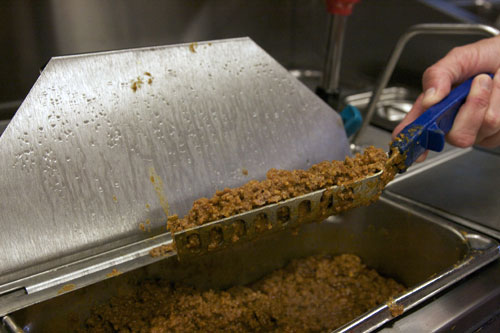
So in summary, there is no such thing as a “Grade-D” beef. Taco Bell does, however, use the lowest quality of meat possible, which also makes it the most affordable. From the information I found, the beef is shipped to locations in 12×8″ clear plastic bags which come in boxes of roughly 20 bags or so. The meat is pre-cooked, and reheated using boiling water. After it’s heated the bag is split open and the meat is put into large metal containers and scooped out as needed.
What about the whole cat food thing?
From what I’ve read, you seriously don’t even want to know what your pet is eating, unless you really do research on what you’re feeding it. Most of the meat put into normal cat food are meat by-products. Seriously, I’m not going into it. Taco Bell for sure uses better meat than what your average cat is getting.
Does Taco Bell beef contain soy?
I did come up with the actual ingredients from the Yum! Brands website and was more surprised to find oats as an ingredient than soy. Here they are.
Beef, Water, Seasoning [Isolated Oat Product, Salt, Chili Pepper, Onion Powder, Tomato Powder, Oats, Soy Lecithin, Toasted Onion Powder, Garlic Powder, Maltodextrin, Sugar, Soybean Oil (Antidusting Agent), Black Pepper, Oregano, Cumin, Autolyzed Yeast Extract, Citric Acid, Caramel Color, Cocoa Powder (Processed With Alkali), Lactic Acid, Natural Flavors, Natural Smoke Flavor, Modified Corn Starch], Salt, Sodium Phosphate.
You may be asking yourself what Soy Lecithin is. Well, Lecithins are oily substances that occur naturally in plants (soybeans) and animals (egg yolks). The soy variety possesses emulsification properties. This means it can keep a candy bar “together” by making sure that the cocoa and the cocoa butter don’t separate. Since soybeans are one of the cheapest crops in the U.S., it makes sense to use a cheap, natural soy derived emulsifier in food processing.
The Soybean Oil is there to do exactly what it says. It reduces the formation of dust during processing and handling
So where does it come from?
I was unable to locate who Taco Bell actually purchases their beef from. This isn’t public information, and I don’t think they’re required to release it. This is something I might keep searching for, so you may hear from me on this topic later on. They do, however, release this statement on their official site:
Taco Bell, Pizza Hut, KFC, Long John Silver’s, and A&W have extremely high food quality and safety standards throughout our entire supply chain. We actively work with our suppliers to raise industry standards. Our rigorous approval process identifies suppliers with proven, outstanding performance in quality control. We expect all of our suppliers to adhere to our strict guidelines so we provide the best possible quality in every meal.
I don’t feel like reading all of that. Just tell me the answer.
Taco Bell does use the lowest possible quality of beef allowed by the USDA., but it’s still a hell of a lot better than what’s in your pet’s bowl. I think another thing that should be taken into account is where the beef is coming from, but I guess that’s just going to have to be for future reading.
Related Posts :
Some time ago, I wrote an article investigating the claim that Taco Bell's beef was of lower quality than the food you feed to your pets. I found that their beef was much higher quality than ...
I would first like to state that I have no knowledge of what Taco Bell uses as meat filler. My best guess is that they are using the same type of soy-based meat-substitute that I make for my fami ...
Let me start by saying that I love Taco Bell. There's just something about it. In my eyes, it is by far the superior choice for fast food. A grilled stuffed burrito with extra baja sauce and a ...
After losing several pounds(and promptly bragging about it), l decided I would completely leap off of the wagon and grab some of Taco Bell's new Fully Loaded Nachos. The Nachos Bel Grande is one ...
I haven't posted something that looks absolutely disgusting delicious in a while so when I came across a forum where a guy had stuffed a roll of sausage with a cheesy double beef burrito from Taco ...


Twitter
Facebook
Youtube
Flickr
{ 29 comments… read them below or add one }
You sir…are a champion. A gentleman and scholar!
HERE HERE! BTW, if I’d have known there’d be a summary at the end, I wouldn’t have read the whole thing. Of course, I am more educated, so good on you for not providing the easy road ahead of time.
My aunt works at taco bell as a manager, the meat is water based
Thank you for the research and the pointer to the web site. I’m celiac (no gluten, e.g., wheat, rye, oats, or barley). The Taco Bell web site clearly points out that almost everything is inedible for a celiac. Now I know – guess I’ll stick to plain, simple, home cooking.
I worked at a McDonalds in high school and I recall the boxes of burgers saying Grade D beef. Ive seen this with my own eyes, I worked the grill. And I know Taco Bell beef is rehydrated beef. It comes in pouches of pebbly powder and you just soak in water. Poof you have meat. I had a buddy that worked there. SO, Im not sure which is worse grade D or rehydrated. And Wendys chili is just old, overcooked hamburger soaked in water in a grabage can for a few days, or until it crumbles. I worked there too. I hate eating this crap but still do rarely.
Dannyg, the meat is not powder, it comes in a bag precooked we drop it in water that is 198 degrees and cooked for 30 min or longer as long as it reaches temps of 165 degrees. The beef has never been rehydrate. Back in the early 90′s we use to fry the beef. The beans at Taco Bell are powder and rehydrated. And I worked at mcdonalds and the boxes never said grade d.
Thanks for the info. I can remember going to to Taco Bell in the seventies as a teenager sitting and eating a half dozen tacos at a time. I remember the meat was feshly cooked and seemed so good! I still eat a TC alot, but for many years have wondered why the meat doesn’t seem as good as I remember it being back then. Now I know. Oh well,sqeeze on an exta packet of hot sauce and I’ll never know the difference. Bon appetit!!
You’re a liar, Danny G. There is no such thing as Grade D as THE ARTICLE STATED.
I also work at taco bell, year and a half… the beef is not re hydrated and it does come in a bag put into a thermalizer for 30 minutes heating it. To answer your question on who specifically packages and processes the beef is “Alpo”, yeah the dog food company. I had asked the supervisor one day and she straight up answered me… very disappointing though.
I know someone higher up within Taco Bell and I was told that their beef mixture used to be about half beef and about half oat filler. They contracted out for the oat filler. It was cheaper than the beef. This may sound gross, but it’s probably better than just eating the beef. Well, Taco Bell recently found a cheaper filler so they fired the oat filler company. This new filler is about half the price of the oat filler. Unfortunately, the cheaper filler is not actually food so TB had to go through a thorough process to make sure it was “OK” for human consumption (checking with legal, food taste panels, etc). I don’t know what assumptions went into this analysis, but I wouldn’t want to chance it. Are they assuming someone would eat two “beef” tacos every three months and that would be safe? Unfortunately in our obese, fast-food loving country, these numbers would be much higher.
Food standards in this country have really gone down the toilet. It’s no wonder everyone is obese and ridiculously unhealthy.
There is a reason fast food is so cheap. They would not sell the product for less than they paid for it (plus some added profit). It’s a simple math equation. I’m not sure why people are always surprised at the standards for these fast food places. They may seem cheap now, but you will eventually pay for it either with money through your increased health care costs, or with time through dying earlier than you would have otherwise.
What is “cheaper filler” that is “not actually food”?!? There are lots of things that are food (rice, flour, beans, fruit) and things that are not (dirt, sand, twigs, weeds). I don’t much care for rice, but I will eat it. It is food. But I don’t want to eat “non-food.” My cat eats “non-food.” How can we find out what “cheaper filler that is not actually food” is? All the Fire sauce in the world won’t fix a “non-food” taco.
I<3meth
Keep in mind that soybean oil is added to prevent dusting in the seasoning, not the meat.
Taco Bell is number one in your heart? Not only are you sad, you have no taste as well.
I currently work there and the new filler is sand. The box we get states an extra ingredient as compared to the ones yum brands releases. Its not secret information. Its on the box. Silicon dioxide. ie: Sand.
Danny g is lying. I currently work at McDonald’s and the meat is definitely not rehydrated. It’s frozen 100% beef and I’m pretty sure it DOES say grade A on the box but ill have to get back to you on that.
I’m curious if the “Grade D” people say they see is a US DOT classification for the shipment. I’ve tried to do some checking, but can’t really find anything.
None of this sounds tasty to me. Thanks SOGOOD for telling me it wasn’t just me about the meat being good back in the 70′s. Didn’t eat Taco Bell for many years and when I tried a taco again in the 90′s I kept saying the meat isn’t good, why? Well, today I learned the dirty little secret about their meat.. I don’t mind a filler, but I do mind not letting the public know in case some are allergic to any of the products they sneak into their food. My mom is horribly allergic to any soy and could become sick. Someone mentioned celiac disease and need to avoid gluten. Taco Bell is treading on thin ice if someone gets
really sick from their lack of disclosure.
Alio, I’m sorry to say that 85% of the processed food at the restaurants and in the grocery stores are soybean based. That’s probably why most people say they have many food allergies when it is indeed just a soybean allergy. I know many pregnant women get massively sick unless they eat home cooked food. It’s either the chemicals and/or the soy.
Did you know that many people are going to farmer’s markets and then the IRS is showing up to tax even them? Did you know that many rich people are dodging taxes by putting their assets in nontaxable venues? Did you know that the Germans buy almost only German made products and they are suffering least during this economic downturn?
Now we know what is in the beef,well i dont eat beef,but if one likes to eat at TB,go ahead and if you don’t like the taste then don’t,its so simple.i my self will not eat beef.
Hi:
The Grade ‘D’ reference may be from Canadian beef std.s
Canada D Grades
The D grades are for mature carcasses and are normally referred to as cow or commercial grades. The Canada D1 grade is given to mature carcasses with excellent muscling and external fat characteristics. The CANADA D2 grade is given to mature carcasses that exhibit weaker muscling and have poorer external fat characteristics such as yellow fat. The CANADA D3 grade is given to mature carcasses that have deficient muscling. The CANADA D4 grade is given to mature carcasses with more than 15 millimetres of external fat over the ribeye.
Hope this helps,
Dave
r those dirty ? answer plz
My mom told me that she saw that Taco Bell makes their burritos with Cat in the news, her local Spanish language station. This sounded really weird to me since I would have heard about it in the news too. Has anybody else heard of this going on?
I just found this on the web. I wonder how truthful this article is. If this is anything like the World News tabloid that I see in supermarkets, I think its all bullsh*t. I would like to hear what others on here think about this.
http://weeklyworldnews.com/headlines/28546/taco-bell-meat/
Wow you are a idiot John and that is your investigation? Did you go to school. I can’t believe I read your article. I won’t be reading any others, what waste of time and space. Did you even read the lawsuit? NO? Did you read the definition of ground beef? No? Did you do anything but feed your face with taco bell then with bias only printed the ingredients via their own web site? You are joke. 400 articles? Now I understand why Jersey Shore is on. There are enough idiots in this country to make even the crappiest of no talent morons in a job.
Ah I saw you finally did take the time to investigate. Good to see you are keeping it honest. It as shame you wrote this article with such bias but you made good when you learned the facts. Maybe your not as bad it seemed.
I don’t know how I just stumbled upon this but I figured I might be able to shed some light on the whole ‘Grade D’ thing. People saying that there is no Grade D beef are correct (at least in the U.S., I do not know about other countries). Grading is the Prime, Choice, Select, Standard, Commercial, Cutter and Utility. HOWEVER, the division between the first four gradings and the last three do have something to do with what people might be confusing for Grade D. Beef cattle are assigned an age grade A-E, younger cattle 9-42 months fall into the A and B range and that beef becomes Prime, Choice, Select, or Standard based on the marbling of the meat. Cattle between the ages of 42-96+ months (roughly) are graded with C,D, or E , with the D grading cattle being between the ages of 72-96 months. These older cattle become Canner, cutter, or utility cuts.
So it is likely that the carcass Grade is a D, being that older cattle are cheaper and tougher they are frequently used in canned and processed meats. This grade doesn’t have anything to do with the elective grading system of Prime, choice, etc., but the USDA does give beef carcasses letter grades before processing as part of the standard inspection.
Commercial, utility, cutter and canner grades of beef are from older animals including bulls and old dairy cows. Nothing is wasted on the farm. The meat is tough and the fat is yellowish. It is perfectly edible if you have all your teeth. Most of the time it is more flavorful than higher grades. It is the source of most of the beef broth available. If you eat it precominuted(cut up or chopped for the dummies) you will have no problem. That’s what hamburger is. Low grade meat actually needs less flavor enhancer than higher grade stuff. Taco Bell uses those other ingredients in very small quantities for flavor, texture, separation, shelf life and other handling characteristics. They’re all approved and mostly naturally derived. If you like the flavor of Taco Bell products. Have at it. They got a bad rap from those idiot lawyers who sued them. Those guys should be slapped both figuratively(with Rule 11 sanctions) and literally (with a big hairy backhand). I’m a food freak lawyer myself. BTW I use USDA commercial leg roasts cooked rare for my Italian beef when I can get them. Sliced to about 1/20 inch on my trusty old Hobart 12″er and dipped into simmering broth makes a perfect Italian beef sandwich. The meat is too thin to be tough and the older beef has a better flavor. If you have never knowingly eaten the lower grades of beef, don’t knock them until you do. Utility grade chopped into 3/8 cubes or ground through a 1/2” plate(about 3/8″ pieces) makes perfect chili meat if you slow cook the meat for a couple of hours with moist heat. I also grind my own burgers, at least 20lb at a time. I use shank meat(tough in any grade), chuck, short rib and cheek meat all ground through a 3/4″ plate separately, mixed leaving 1/2 if the shank meat aside, then ground through a 1/2″ plate. The set aside shank is ground down to 1/8″ then passed through again to make meat paste which is mixed with the rest. It looks greasy and pasty, but there’s no fat in the shank. It binds the bigger pieces together perfectly and the look disappears over the grill for a perfect burger. Not all lawyers are stupid jerks, but don’t get me started on those who are.