Update (1/25/11): This article is research done by me to investigate the quality and ingredients in Taco Bell’s beef. In my opinion, it offers the most information on this subject available to the general public.
For more information regarding the recent lawsuit filed against Taco Bell’s beef “product”, go here.
Ever since I can remember, I have always loved Taco Bell. I still do love Taco Bell. When it comes to fast food, it will always be number one in my heart. Despite all the warnings against eating fast food, I have never been able to resist it. McDonalds and Burger King have recently been ruled out of my diet, but sometimes I get a craving and have to stop into TB for a grilled stuffed burrito, chicken quesadilla, and a bucket of Pepsi. I need you to understand this before you read the following. I adore Taco Bell. I will probably never stop adoring Taco Bell. I’m not trying to tell you what to eat, or expose you to the harsh cruelty that is the fast food industry. I simply am curious where my food comes from. I think it’s something that most people should wonder.
I have always been curious about the rumors that Taco Bell uses “Grade-D” meat. You know, that whole thing where cat food uses “Grade-C” meat, so eating Taco Bell is far worse than eating cat food. I decided to do as much research as I could find out if these rumors were true, or just a made up story to destroy children’s love for good ol’ TB.
Grade-D Meat? Come on, John…
For starters, I’m completely aware that there is no such thing as “Grade-D” meat. If we’re talking about beef, the U.S. Department of Agriculture(USDA) doesn’t even use letter grades. There’s no such thing as Grade A beef, or Grade F beef. The inspection and grading of meat and poultry are two separate programs within the U.S. Department of Agriculture(USDA). Inspection for wholesomeness is mandatory and is paid for out of tax dollars. Grading for quality is voluntary, and the service is requested and paid for by meat and poultry producers/processors.
Since the Federal inspection program began at the turn of the century, the meat and poultry industries have grown and changed significantly. In the early 1900’s, most meat came from local slaughter plants and was used locally. Further processing was limited to simple products such as sausages. Today, with the increase in fast food and other meat industries, a wide variety of meat and poultry products are on the market. Animals are slaughtered and meat is processed in sophisticated, high-volume plants. The meat is often shipped great distances to reach consumers.
After the meat and poultry are inspected for wholesomeness, producers and processors may request to have the products graded for quality by a licensed Federal grader. The USDA’s Agricultural Marketing Service is the agency responsible for grading the beef. Those who request grading must pay for the service. Grading for quality means the evaluation of the meat such as tenderness, juiciness, and flavor of meat.
USDA grades are based on nationally uniform Federal standards of quality. No matter where or when a consumer purchases graded meat or poultry, it must have met the same grade criteria. The grade is stamped on the carcass or side of beef and is usually not visible on retail cuts. However, retail packages of beef will show the U.S. grade mark if they have been officially graded.
- Prime grade is produced from young, well-fed beef cattle. It has abundant marbling and is generally sold in restaurants and hotels. Prime roasts and steaks are excellent for dry-heat cooking (broiling, roasting, or grilling).
- Choice grade is high quality, but has less marbling than Prime. Choice roasts and steaks from the loin and rib will be very tender, juicy, and flavorful and are, like Prime, suited to dry-heat cooking. Many of the less tender cuts, such as those from the rump, round, and blade chuck, can also be cooked with dry heat if not overcooked. Such cuts will be most tender if “braised” — roasted, or simmered with a small amount of liquid in a tightly covered pan.
- Select grade is very uniform in quality and normally leaner than the higher grades. It is fairly tender, but, because it has less marbling, it may lack some of the juiciness and flavor of the higher grades. Only the tender cuts (loin, rib, sirloin) should be cooked with dry heat. Other cuts should be marinated before cooking or braised to obtain maximum tenderness and flavor.
- Standard and Commercial grades – are frequently sold as ungraded or as “store brand” meat.
- Utility, Cutter, and Canner grades are seldom, if ever, sold at retail but are used instead to make ground beef and processed products.
Taco Bell uses “cutter” beef, which is what almost all ground beef is. Basically they grind up the leftover trimmings that didn’t make the best cuts. But, it is all cow meat and by law cannot contain cow organs or tendons or hooves or anything except cow meat. So Taco Bell uses low quality, but perfectly safe ground beef. However, since this stuff isn’t flavorful by itself, so they process the shit out of it by adding ‘natural’ flavoring, salt, sugar, caramel color.
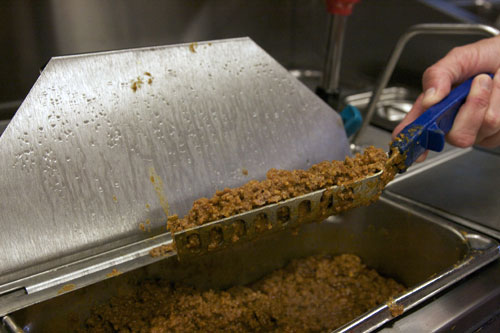
So in summary, there is no such thing as a “Grade-D” beef. Taco Bell does, however, use the lowest quality of meat possible, which also makes it the most affordable. From the information I found, the beef is shipped to locations in 12×8″ clear plastic bags which come in boxes of roughly 20 bags or so. The meat is pre-cooked, and reheated using boiling water. After it’s heated the bag is split open and the meat is put into large metal containers and scooped out as needed.
What about the whole cat food thing?
From what I’ve read, you seriously don’t even want to know what your pet is eating, unless you really do research on what you’re feeding it. Most of the meat put into normal cat food are meat by-products. Seriously, I’m not going into it. Taco Bell for sure uses better meat than what your average cat is getting.
Does Taco Bell beef contain soy?
I did come up with the actual ingredients from the Yum! Brands website and was more surprised to find oats as an ingredient than soy. Here they are.
Beef, Water, Seasoning [Isolated Oat Product, Salt, Chili Pepper, Onion Powder, Tomato Powder, Oats, Soy Lecithin, Toasted Onion Powder, Garlic Powder, Maltodextrin, Sugar, Soybean Oil (Antidusting Agent), Black Pepper, Oregano, Cumin, Autolyzed Yeast Extract, Citric Acid, Caramel Color, Cocoa Powder (Processed With Alkali), Lactic Acid, Natural Flavors, Natural Smoke Flavor, Modified Corn Starch], Salt, Sodium Phosphate.
You may be asking yourself what Soy Lecithin is. Well, Lecithins are oily substances that occur naturally in plants (soybeans) and animals (egg yolks). The soy variety possesses emulsification properties. This means it can keep a candy bar “together” by making sure that the cocoa and the cocoa butter don’t separate. Since soybeans are one of the cheapest crops in the U.S., it makes sense to use a cheap, natural soy derived emulsifier in food processing.
The Soybean Oil is there to do exactly what it says. It reduces the formation of dust during processing and handling
So where does it come from?
I was unable to locate who Taco Bell actually purchases their beef from. This isn’t public information, and I don’t think they’re required to release it. This is something I might keep searching for, so you may hear from me on this topic later on. They do, however, release this statement on their official site:
Taco Bell, Pizza Hut, KFC, Long John Silver’s, and A&W have extremely high food quality and safety standards throughout our entire supply chain. We actively work with our suppliers to raise industry standards. Our rigorous approval process identifies suppliers with proven, outstanding performance in quality control. We expect all of our suppliers to adhere to our strict guidelines so we provide the best possible quality in every meal.
I don’t feel like reading all of that. Just tell me the answer.
Taco Bell does use the lowest possible quality of beef allowed by the USDA., but it’s still a hell of a lot better than what’s in your pet’s bowl. I think another thing that should be taken into account is where the beef is coming from, but I guess that’s just going to have to be for future reading.